
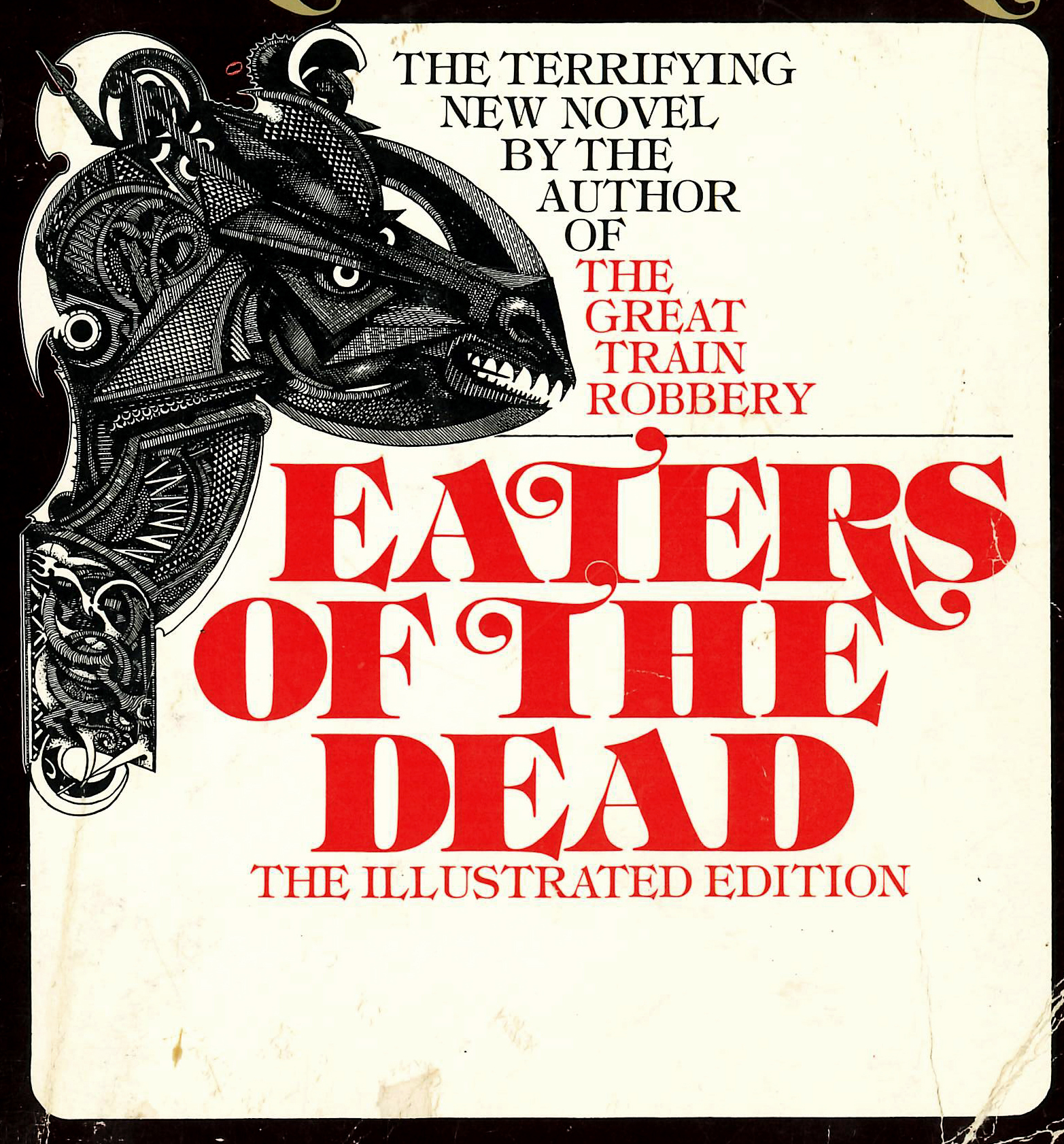
Michael Crichton’s 1976 novel Eaters of the Dead is a gripping historical adventure set in the 10th century. It follows Ahmad ibn Fadlan, a real Arab traveller and diplomat from Baghdad, who becomes swept up in a Viking quest to defend a Scandinavian kingdom from savage marauders.
The novel originated from a friendly wager during Crichton’s career as a writer and filmmaker. A friend lectured on the “Bores of Literature,” dismissing Beowulf as uninteresting. Crichton countered that the epic could be compelling if presented effectively. As he later explained:
The short version is, I wrote Eaters of the Dead on a bet that I could make an entertaining story out of Beowulf. It’s an unusual book. Readers either like it, or they hate it
Eaters of the Dead blends fact and fiction and is presented as a scholarly edition of ibn Fadlan’s lost 10th-century manuscript, complete with footnotes, appendices, and an academic tone. The first three chapters closely adapt ibn Fadlan’s authentic Risala (his real travel account), which documents his encounters with the Rus’ (Viking-like peoples on the Volga River). The narrative then transitions into a rationalized retelling of the Anglo-Saxon epic Beowulf, grounding its mythic elements in plausible anthropology and evolutionary science. Through ibn Fadlan’s cultured, initially appalled perspective (softened by growing respect and adaptation), Crichton explores clashes between Islamic refinement and Norse brutality, hygiene, sexuality, and worldview.


The Real Ahmad ibn Fadlan
Ahmad ibn Fadlan (born around 877 AD) was a 10th-century Arab Muslim scholar, faqih (expert in Islamic jurisprudence), and diplomat in the Abbasid Caliphate’s court under Caliph al-Muqtadir. In 921–922 AD, he joined an embassy traveling over 4,000 kilometres from Baghdad to the Volga Bulgars, who had requested aid, religious instruction in Islam, and diplomatic ties after conversion.
His Risala, a detailed travelogue preserved fragmentarily, is a primary source for medieval ethnography. It vividly describes peoples encountered along the route, including Turkic groups and especially the Rus’ (Volga Vikings). Ibn Fadlan noted their striking physical appearance (“the most perfect physical specimens,” tall, blond, and ruddy), but expressed disdain for their customs: poor hygiene (“the dirtiest of God’s creatures”), shared washing basins, casual nudity and sexuality, polyamory, ritual human sacrifice (notably in a dramatic ship burial), and boisterous feasting. Written from an Islamic perspective, the account highlights profound cultural clashes while acknowledging their trade skills and prowess.
The real Risala ends at the Volga with diplomacy and ethnographic observations; Crichton uses this as a foundation for his novel, faithfully adapting the early chapters before diverging into fiction.

The Story
The story begins in 922 AD with ibn Fadlan, a refined courtier, being dispatched by the Caliph of Baghdad as an ambassador to the King of the Volga Bulgars. Ibn Fadlan is appalled by the harsh northern landscapes and the peoples he encounters on his travels. En route, he encounters a group of Rus’ (Vikings) on the Volga River and witnesses their crude customs, poor hygiene, ritual sacrifices, polyamory, and boisterous feasting, which he describes with detached disdain but growing fascination. He also includes vivid details like a Viking chieftain’s funeral involving a ship burial and human sacrifice.
The narrative shifts when the Rus’ leader dies and the heroic warrior Buliwyf ascends. A messenger from distant King Rothgar arrives, pleading for aid against terrifying “mist-monsters” that conduct nightly raid on his hall, Hurot. These savage, bearskin-clad cannibals who devour the dead are referred to in the novel as the Wendol. A soothsayer decrees that Buliwyf must lead 12 warriors plus a 13th “foreigner,” forcing the unwilling ibn Fadlan to join the quest.
The group sets out for Rothgar’s kingdom, sailing northwards through treacherous seas. Aided by interpreter Herger, ibn Fadlan adapts to Viking ways: learning to fight, ride horses, and begins to understand and embrace their fatalistic worldview. On arrival they find Hurot Hall, a grand but arrogant structure, under siege with the Wendol launching brutal nocturnal raids. Buliwyf takes command and though suffering heavy losses the group repel the initial attacks.
The warriors retaliate, taking the fight to the Wendol, and infiltrate their misty sea-caves, slaying their matriarchal “mother” in a gruesome battle which leaves Buliwyf poisoned with venom. Returning to Hurot, they face a final onslaught of fire-bearing Wendol and, in a heroic stand, Buliwyf leads the defence, defeating the horde but succumbing to his injuries.
The narrative ends abruptly, as ibn Fadlan’s manuscript cuts off mid-journey home, mirroring the fragmentary survival of the real Risala


Connections to Beowulf
Crichton was open from the outset about the influence of Beowulf on his novel which is fundamentally a modern retelling and rationalization of the Old English epic. He aimed to demonstrate that, when reframed with fresh perspective and exciting presentation, Beowulf‘s core story of heroic monster-slaying, cultural clashes, and themes of fate and heroism, remains thrilling and relevant.
The narrative structure of Eaters of the Dead mirrors Beowulf‘s key plot arcs, particularly the first two monster battles, while condensing and omitting the dragon episode from the poem’s second half (though elements like a perceived “fire-dragon” appear as torch-bearing attackers). Parallels include:
- Hero and Mission: Buliwyf acts a stand-in for Beowulf. He is the heroic warrior leader who answers a call for aid against monstrous threats. Like Beowulf, he travels to aid a king (Rothgar = Hrothgar) whose hall (Hurot = Heorot) is besieged by nocturnal attackers.
- Monsters: The Wendol are the novel’s stand-in Grendel (a savage, man-eating outsider raiding the hall) and his mother (the vengeful matriarch slain in her lair). Crichton euphemizes them as relict Neanderthals or prehistoric humans, survivors of an Ice Age population, rather than supernatural demons, aligning with his scientific mindset while preserving the primal horror and outsider threat of the originals.
- Heroic Deeds: The hall defence against the Wendol echoes Beowulf’s unarmed wrestling with Grendel. The infiltration of the misty sea-cave lair to kill the “mother of the Wendol” reworks Beowulf’s underwater battle with Grendel’s mother. The final fiery assault and Buliwyf’s heroic death after victory evoke Beowulf’s fatal dragon fight and barrow burial.
- Cultural and Thematic Elements: Both works emphasize warrior codes, loyalty, fame through deeds, and the cycle of violence. Crichton adds a multicultural layer through Ibn Fadlan’s narration, whose outsider perspective heightens the clash between refined Islamic culture and brutal Norse ways and provides opportunity for ethnographic observation.
The text is peppered throughout with footnotes providing historic, archaeological and geographic commentary which enhance the framing of the narrative as a translated manuscript. In the Appendix, ‘The Mist Monsters’, Crichton outlines a short pseudo-anthropological discussion of Ibn-Fadlan’s Wendol as possible Neanderthal remnants, and interweaves real and fictional archaeology and research to imbue the story with greater historic authenticity. This is further enhanced by a bibliography which mixes real and fictional references; The book wears its influences on its sleeve with the final general reference being to Abdul Alhazred’s Necronomicon.
The 13th Warrior
The novel was adapted into a feature length historic action-adventure movie released in 1999 starring Antonio Banderas as ibn Fadlan (with a brief cameo by Omar Sharif). Retitled as The 13th Warrior, the film’s narrative follows that of the book with Banderas as an exiled poet from Baghdad who joins a band of Norse warriors to battle mysterious cannibalistic creatures. The production emphasized practical sets, Viking-era authenticity in costumes and weapons, and large-scale action sequences.
Touchstone Pictures greenlit the project under the working title Eaters of the Dead, with John McTiernan (Die Hard, Predator) attached to direct and with Crichton as co-producer and co-writer.
Production was notoriously troubled with early cuts testing poorly with audiences, leading to significant issues including major budget overruns and creative differences which ultimately led to McTiernan being sidelined and Crichton himself stepping in to direct reshoots. On release the film performed poorly against its budget and received mixed reviews with negative comments highlighting the thin plot, disjointed editing, and unresolved subplots.
The 13th Warrior is however considered by many to be an underrated gem, boasting a strong atmosphere and cinematography, and is carried by an engaging performance by Banderas and supporting cast, with a particular highlight in his rapport with Dennis Storhoi’s Herger.


Eaters of the Dead stands as one of Michael Crichton’s most inventive works, transforming the epic of Beowulf into a gripping, cross-cultural adventure through the innovative lens of a real historical eyewitness. By grounding ancient myth in plausible anthropology and evolutionary speculation, Crichton not only demystifies monsters but also celebrates the raw heroism and fatalistic spirit of the Viking world—while challenging the outsider (ibn Fadlan) to find common humanity amid profound differences. The novel’s enduring appeal lies in its brisk pacing, atmospheric immersion, and bold fusion of fact and legend, making it a compelling bridge between scholarly history and pulse-pounding storytelling. Its legacy lives on not just in the cult-favourite film adaptation but in how it continues to inspire readers to reconsider timeless tales through fresh, rational eyes.
Leave a Reply