
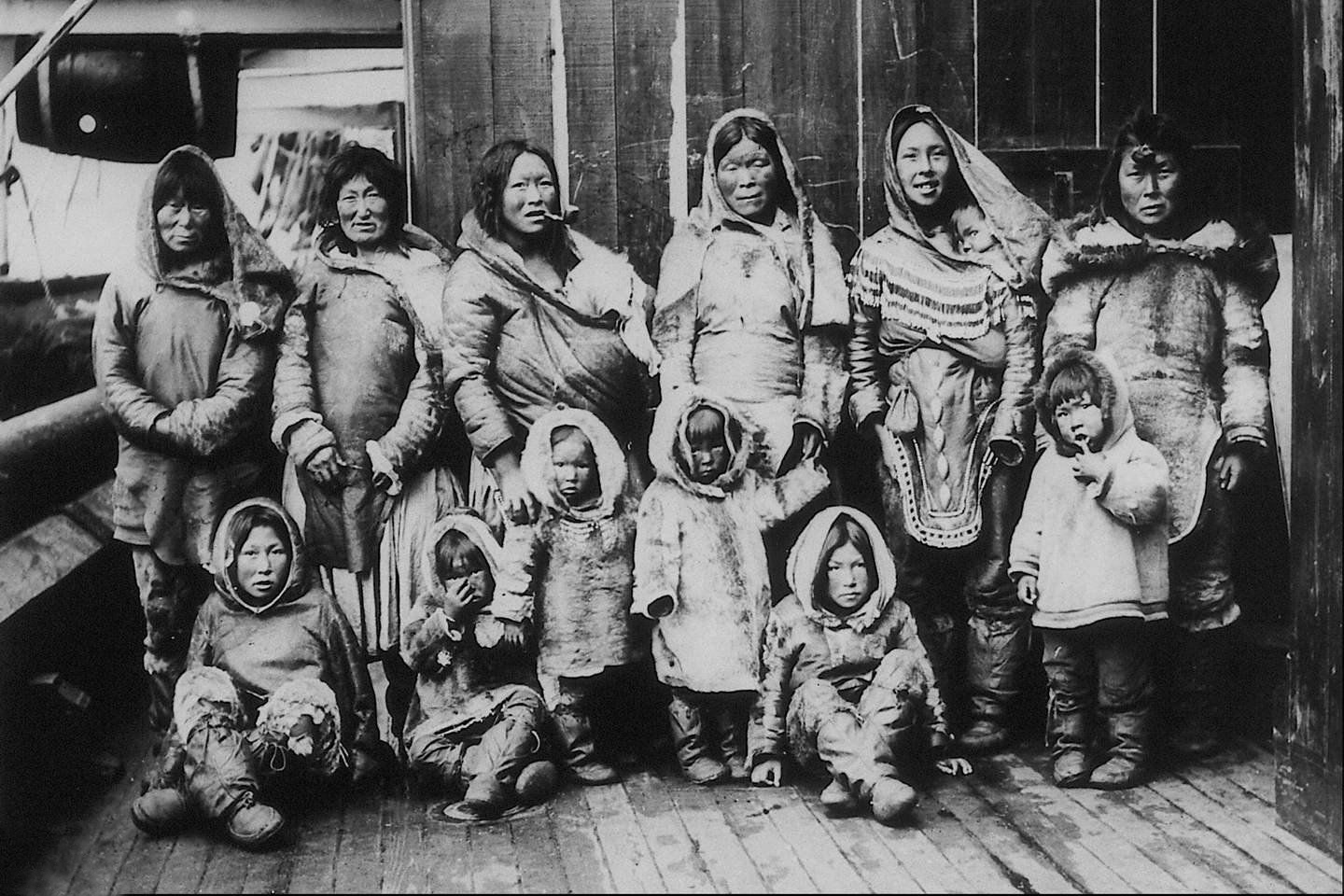
Sedna is the central sea goddess in traditional Inuit religion and cosmology, particularly in the Eastern Arctic (Canada and Greenland). Archaeologically and ethnographically, Sedna is understood as the mistress or mother of marine mammals who resides in the ocean depths and governs seals, walruses, whales, and other sea creatures essential to Inuit survival. She is often associated with Adlivun (the Inuit underworld or land of the dead beneath the sea). Interaction between the Inuit and Sedna was mediated by shamans who entered into trance journeys to appease her and ensure hunting success.
Here we will examine her core myth, shamanic role, associated taboos, indirect archaeological traces from Dorset and Thule cultures, ethnographic documentation, and persistence in contemporary Inuit art.

The Core Narrative
The core Sedna myth is a foundational creation narrative in Inuit oral tradition, explaining the origin of marine mammals and the establishment of Sedna as the mistress/mother of sea animals and ruler of the underwater realm (she is also known regionally by variant names such as Nuliajuk, Takannaaluk, Sassuma Arnaa (“Mother of the Deep”), Arnakuagsak, or Takanakapsaluk).
The myth exhibits significant regional and teller variation, with no single canonical version due to oral shamanic traditions which are open to adaptation over time and region.
Sedna begins as a young woman (often presented as beautiful, wilful, or reluctant to marry) living with her father who pressures her to wed. Sedna however rejects her suitors who are portrayed variously as human hunters or deceptive spirits such as petrel disguised as a man.
In one of the most common motifs (prominent in Boas’s Baffin Island versions), she marries a bird-spirit suitor who promises abundance but reveals his true form, mistreating her on a remote island or cliffside nest. She calls to her father for rescue during a storm who arrives by boat to carry her off but the bird-spirit pursues them.

In desperation or anger, the father throws Sedna overboard to lighten the boat or appease the pursuer. As she clings to the gunwale, he chops off her fingers (joint by joint) with a knife or axe to force her release. Her severed finger segments fall into the sea and transform into the various marine mammals: the first phalanges become seals, middle segments walruses, fingertips whales (or variations like narwhals, belugas). Sedna sinks to the ocean floor, where her mutilated hands become the source of all sea creatures. She settles in the depths (often Adlivun, the Inuit underworld beneath the sea), becoming the powerful, ambivalent controller of marine game.
In some Igloolik versions, Sedna is a giant child who attacks her parents. Greenlandic Sassuma Arnaa tales emphasize her as “Mother of the Deep” whilst Alaskan variants sometimes overlap with other sea spirits. Sedna’s ambiguity allowed for regional adaptation and flexibility in the way in which she influenced daily activity and shamanic rituals.
Human Interaction
Inuit survival depended almost entirely on marine hunting in a harsh, unpredictable environment. The mythical transformation narrative established Sedna’s nature as a creator and sustainer of life-giving sea resources, and also that animals would not merely resources to be exploited but sentient beings possessing souls (inua) and were therefore deserving of respect and reverence.
This belief led to the development of ‘taboos’ which were strict cultural rules, prohibitions and observances which were followed by Inuit communities and governed many aspects of their lives. Taboos were moral and practical guidelines rooted in Inuit cosmology which ensured harmony with the spiritual world, particularly with Sedna and the marine animals which were under her domain. Violating the rules insulted Sedna and polluted the spiritual realm, resulting in storms, illness and Sedna withholding game animals which risked the survival of the community. The offences were symbolised as ‘dirt’ which drifted down into the depths of the sea, tangling and polluting Sedna’s hair.


One of the most widespread and immediate rituals involved showing respect to the animal’s soul right after a kill. Hunters poured or dripped fresh water into a killed seal’s mouth to symbolise gratitude for the animal offering its body, and to appease its soul. Adhering to this taboo ensured the animal’s soul returned to Sedna satisfied, encouraging her to release more game. Variations of this ritual applied to whales and fish. There were taboos around the respectful handling of carcass processing, ensuring all usable parts were used; wasting food risked offending Sedna and punishment through starvation and bad weather.
Shamans (angakkuq) served to mediate and intercede with the spiritual realm on behalf of the community. The angakkuq possessed specialized knowledge and power acquired through rigorous initiation, often involving fasting, exposure to cold, visions, or encounters with spirits. Shamans could transcend physical boundaries, entering altered states to interact with nonhuman entities. One of their most important functions involving Sedna was the trance journey, typically induced by drumming, singing, chanting, or rhythmic movement, which allowed their soul to leave their body and travel to Sedna’s domain. On reaching Sedna they would comb and untangle her filthy hair, symbolically removing accumulated human taboos and transgressions. The shamans could also confess community offenses, beg forgiveness on behalf of the group, or negotiate with Sedna.

Archaeology
Direct evidence for Sedna or equivalent deities is very limited, partly because there was no ‘canonical’ iconography, but also in large part because Inuit spiritual traditions were shamanistic, orally transmitted and non-monumental in that no shrines, temples or inscribed texts were created. Pre-contact sites yield tools, dwellings, faunal remains, and portable carvings, but no artefacts which are explicitly labelled or stylistically unique to Sedna.
The two main sequential phases of human occupation in the eastern Arctic where Sedna’s mythology and associated shamanic practices are most strongly documented are the Dorset and Thule Cultures.
The Dorset culture (also called Dorset Palaeo-Inuit) was a prehistoric Indigenous Arctic society that thrived in the eastern North American Arctic, including much of present-day northern Canada and parts of Greenland. It represents one of the major palaeo-Inuit traditions in the region, lasting from approximately 500 BC to c1300-1500 AD. They were highly specialized hunter-gatherers adapted to extreme cold, and who relied primarily on sea mammals (ringed seals, bearded seals, walrus, occasionally narwhal and beluga) supplemented with fishing, bird hunting, and limited land mammals. A striking aspect of the late Dorset is rich portable art including animal and human figurines and masks.
One of the most important Dorset sites is Shuldham Island 9 (approximately 500 BC-1000 AD) where seven semi-subterranean houses and stone walls were investigated. Among the thousands of artefacts were miniature soapstone figurines of bears, owls, birds, fish and masks. Shamanic artefacts included human figurines in swimming and flight poses, including one with a deep back slot and incised abdomen, potentially suggestive of ritual killing. The assemblage was interpreted as deriving from a shamanic ‘tool kit’ relating to a variety of activities requiring divine invocation and trance journeys.
The peoples referred to as the Thule culture are the direct ancestors of the modern Inuit. The culture developed along the Arctic coast in northern Alaska in around 1000 AD, spreading eastward and reaching Greenland by the 12th century during a medieval warm period. Thule people developed a highly specialized maritime adaptation focused on open-water hunting of large sea mammals, especially bowhead whales, which provided massive resources: meat, blubber (for fuel and food), bone/ivory (for tools and architecture), and baleen. This contrasted with earlier Paleo-Inuit groups like the Dorset, who relied more on ice-edge seal hunting without large boats or dogs. They also developed permanent settlements with semi-subterranean houses built of rocks and whale bones and covered with skin and sod. Thule sites are widespread, from Alaska to Greenland, with excellent preservation in permafrost. Artifacts often include elegantly crafted harpoon heads, whalebone structural elements, and incised scenes of boats/animals, illustrating idealized hunting protocols.
A notable Thule Culture archaeological site is Brooman Point Village (1000-1200 AD) which was excavated in the 1980s. The site includes twenty winter houses, of which only 4 or 5 were occupied simultaneously. These were constructed from the bones of at least 20 bowhead whales and it was determined that the village overlay an earlier Dorset culture village. The character of the site and artefactual evidence underscore the complexity of the whaling culture: whale ivory tools were found in abundance and an incised roof support was found which depicts seven figures in a boat approaching a whale.

Another site, Qariaraqyuk (1200-1450 AD) is among the largest eastern Arctic dwelling sites. The site’s fifty-seven houses show considerable complexity and there is an abundance of whaling gear and ivory whale figurines believed to have been attached to ceremonial vessels. These were used as part of rites of ‘giving a drink’ to harvested whales, a practice which honoured marine animal spirits and appeased Sedna. Other artefacts were found which included incised pictorial scenes of whaling, and which together build up a visual record of hunting and processing protocols which emphasise respect for whales as beings linked to an underwater spiritual realm.
Throughout the archaeological record the influence of Sedna is inferred through material symbolism, such as patterns in the use of sea-mammal resources, shamanic artefacts interpreted via ethnographic analogy, and rare incised scenes of marine hunting. While direct representations of her are absent from the archaeological record, several artefact classes are inferred through ethnographic analogy to be associated with her and with rituals of reverence or mediation: walrus and whale ivory tools, combs, whale figurines, incised whaling scenes, whale bone architecture, and shamanic amulets, often recovered from ritual deposits or gendered house spaces. Notably, ivory from walrus and whale—creatures under Sedna’s domain—dominated the crafting of sea-hunting weapons and women’s implements such as combs and needles, whereas materials from land animals (such as caribou antlers) were primarily used for land-hunting gear and summer tools. These patterns in material culture demonstrate how reverence for Sedna could be embedded in everyday tools; for example, combs served practical purposes but carried symbolic links to the shamanic act of untangling her hair to erase transgressions and breaches of taboos, thereby restoring harmony and ensuring marine abundance.

Ethnography and Modern Context
European contact with the Inuit largely began between the 16th and 18th centuries, through explorers, whalers and traders. By the 19th century, missionaries and fur trade companies such as the Hudson’s Bay Company had established stations in the region.
New tools and weapons including metal knives and firearms began to replace bone and ivory and the Inuit shifted from subsistence hunting to commercial trapping. Resettlement and displacement into permanent settlements fragmented communities, eroded traditional culture and fostered a reliance on welfare, state education and healthcare. Missionary efforts promoted Christianity and reduced the role of shamanism and taboos, relegating Inuit cosmology to folklore rather than rituals embedded in daily life. The transformation of hunting practices and associated economy displaced the role of Sedna and erased the need for spiritual mediation for hunts and animal processing.

Two individuals figure prominently in the ethnographic documentation and preservation of the Inuit mythos: Franz Boas (1858-1942) was a German-American anthropologist who immersed himself in Inuit life and recorded oral traditions and collected stories and songs. He recorded one of the earliest detailed accounts of the Sedna narrative, noting her dual-nature and nurturer and vengeful enforcer, and he linked this to shamanistic rituals where angakkuq journeyed to her realm to comb her tangled hair and release game.
Knud Rasmussen (1879-1933) was half Danish, half Inuit and therefore fluent in Inuktitut from childhood. Rasmussen collected over 20,000 artifacts, biological data, and recorded extensive oral histories, legends and spells. He detailed Sedna myths from Igloolik, Netsilik, and other Central Inuit communities and recorded vivid accounts of trance journeys to Sedna’s underwater home, hair-combing ceremonies, and taboos linking human morality to marine abundance.
Such documentation helped to preserve Inuit culture heritage, and ensure the continuation of orally transmitted folklore, rules, wisdom and rituals.
The mid-20th century saw an Inuit art boom coinciding with establishment of carving cooperatives, government programs and commercial demand. Through this artistic process Sedna, for the first time, developed a recognisable iconography and consistent visual convention, in which she is depicted in a mermaid form with human upper body and fish or marine-mammal tail, and retaining her long hair. As part of this transformation Sedna retained her core narrative aspects with her visual language being filtered through existing Western mermaid tropes.
In the modern-day context of cultural revival Sedna has come to serve as an important symbol of Inuit cultural identity, and through her connection to the sea and marine life, has also become a powerful symbol for environmentalism and ecological management.
Leave a Reply